Print a template.
Fold it tonight.
Every construction template from AFS Paper Airplanes, free to print. Build planes that climb past a two-storey building, level off, and meander home in a slow, steady glide.
Pick a plane.
Each design has its own printable template, difficulty rating and flight character. If this is your first, start with the Eagle.
 More wing area
P12 · F-22 Raptor
Raptor
Wider M-fuselage for extra lift. Flaps sit closer to the centre of gravity, so adjustments stay subtle.
More wing area
P12 · F-22 Raptor
Raptor
Wider M-fuselage for extra lift. Flaps sit closer to the centre of gravity, so adjustments stay subtle.
 Cargo-style
P13 · C-27J Spartan
Spartan
Inverted fuselage, longer body and a joined tail. The body hangs below the wings — bird-like stability.
Cargo-style
P13 · C-27J Spartan
Spartan
Inverted fuselage, longer body and a joined tail. The body hangs below the wings — bird-like stability.
 Twin-boom tail
P14 · O-2 Skymaster
Skymaster
Hollow inverted fuselage and a big joined tail. Less rigid, but a huge control surface.
Twin-boom tail
P14 · O-2 Skymaster
Skymaster
Hollow inverted fuselage and a big joined tail. Less rigid, but a huge control surface.
 Tailless
P15 · X-44 MANTA
Manta
The M-fuselage doubles as the rear stabiliser — no tail. Hard to tune, rewarding when it works.
Tailless
P15 · X-44 MANTA
Manta
The M-fuselage doubles as the rear stabiliser — no tail. Hard to tune, rewarding when it works.
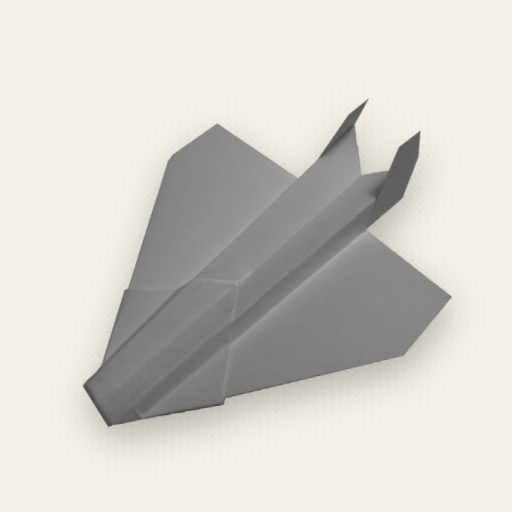
 Flying wing, fastest
P16 · Rockwell X-30
NASP
All wing, no fuselage. Twin tails give just enough yaw stability. Cuts the air like a dart.
Flying wing, fastest
P16 · Rockwell X-30
NASP
All wing, no fuselage. Twin tails give just enough yaw stability. Cuts the air like a dart.

What you'll need
- Basic 8.5in × 11in printer paper. The designs fly great on regular paper, but 32lb/ream stock holds its shape better in flight, giving higher and more exciting flights.
- A pair of scissors sharp and small enough to make precise cuts.
- Clear adhesive tape.
- A paper clip — the planes are designed around #1 size clips, 3.2cm × 0.8cm.
- Optionally a straight edge or ruler, if you don't trust your folds.
The fold legend
Every template uses the same three line types.
- Cut out the rectangular template. Leave the dashed-line cuts for later.
- The template is about 4.25in × 5.5in — half a sheet of letter paper. Print at 100%, with shrink-to-fit turned off, so it comes out at the right size.
- Once you're comfortable with the design, you can skip the template and just cut regular printer paper in half.
- The printed fold lines should be very close to perfect, but if you have to choose, always choose symmetry of the plane over following the printed lines.
Where the designs come from.
These planes began with an award-winning science fair experiment — a wind tunnel built in a garage to test and refine airfoil designs. Years and many revisions later, six were selected and tested to make sure anyone could rebuild them. The ebook adds step-by-step folding instructions, a fine-tuning guide, flight theory, and games to play with the finished planes.